
You train your muscles to stay fit, you eat biodynamically to stay healthy. But what are you doing for your mental fitness? Sports educator Horst Lutz built a training method around exactly that question — one that sharpens brain performance through unusual movements and perception and cognition tasks. It’s called Life Kinetik.
Want to concentrate better at work, boost your creativity, build resilience to stress, become more attentive and better coordinated, and pick up some self-confidence along the way — or simply improve your athletic performance? You might be wondering how on earth that’s supposed to work.
Horst Lutz, a certified sports teacher, has the answer. Nearly 16 years ago, at a seminar, he noticed something strange about himself: despite being in excellent physical shape, he struggled to coordinate rapid changes in movement, and the result was total physical chaos. That got him thinking. He started asking how the brain forms new connections — synapses — the very things responsible for learning. What he found was that the brain responds to movement almost like a muscle, constantly adapting to new challenges. The more demanding the task, and the more brain regions it engages, the more connections form between brain cells, and the more effective the training effect. That insight became the foundation for the Life Kinetik program.

How does Life Kinetik work?
Learning requires the brain to release dopamine, and that only happens when you have a concrete goal in mind or you’re genuinely enjoying the task at hand — a useful tip for any teacher. Life Kinetik puts that insight to work by constantly introducing new movement challenges you’ve never practiced before. The point isn’t the destination — it’s the process, and above all, it should be fun. The exercises need to be demanding enough that you can’t nail them on the first try. And once you’ve pulled one off successfully two or three times, it’s time to move on to a different variation. In today’s achievement-obsessed culture, this kind of training — one that isn’t about hitting targets or acquiring knowledge — can be a hard sell. Here, you’re not training toward a result, but for a set amount of time: 60 minutes a week. A classic exercise is the “parallel ball.” You hold your arms parallel, at 90 degrees in front of your body, a juggling ball in each hand. Then you toss both balls into the air at once, cross your arms mid-throw, and catch each ball with the opposite hand. Almost nobody nails it right away — but the fun factor is high, and it lights a competitive spark. Once you get the hang of it, you move on to the next variation, maybe crossing your arms the other way this time, and suddenly it’s a fresh challenge all over again. That keeps the brain constantly on its toes, developing new strategies to master the task.

The training
A classic Life Kinetik training program runs about 60 minutes a week over 12 weeks, led by a certified Life Kinetik coach. The exercises are designed to engage as many brain regions as possible — visual, auditory, and somatosensory elements that draw on balance, joint position, direction and speed of movement, and touch. Some exercises train eye focus, directional hearing, or stability on unstable surfaces. Cognitive elements come into play too, like mental math, creativity exercises, and memory and matching tasks. The twelve-week program follows a fixed structure that only a certified Life Kinetik coach is qualified to design, tailored to the group in question — children, seniors, or athletes, for instance. After the 12-week course, participants can measure their progress with an attention test.
“Above all, Life Kinetik has to be fun!”
Horst Lutz, certified sports teacher and inventor of Life Kinetik
What does Life Kinetik actually do for you?
More than 40 independent studies, spanning subjects from elementary school children to athletes to seniors, have turned up striking results. Of course, no one should expect miracles — Life Kinetik isn’t a magic cure. But it’s well established that regular training, just 60 minutes a week, improves both mental and physical well-being. Physical and psychological performance both climb. Participants reported feeling more relaxed, sleeping better, and becoming more receptive, attentive, and focused, with less susceptibility to stress after 12 weeks. The effects run deeper still: Life Kinetik trains balance and coordination, which can lower the risk of falls. One of the most striking findings, to me, was its effect on fluid intelligence — the ability to solve novel problems. Elementary school children who trained saw their grades improve, reading more fluently, sharpening their math skills, and concentrating better in class. It might be worth considering Life Kinetik as a school subject in its own right.
More than 60 minutes a week doesn’t add extra benefit, but the time can be split — two 30-minute sessions or six 10-minute sessions work just as well. Naturally, everyone responds differently to the training, and it’s worth stressing that Life Kinetik isn’t therapy — it’s a training method delivered by certified coaches.
Who is Life Kinetik for?
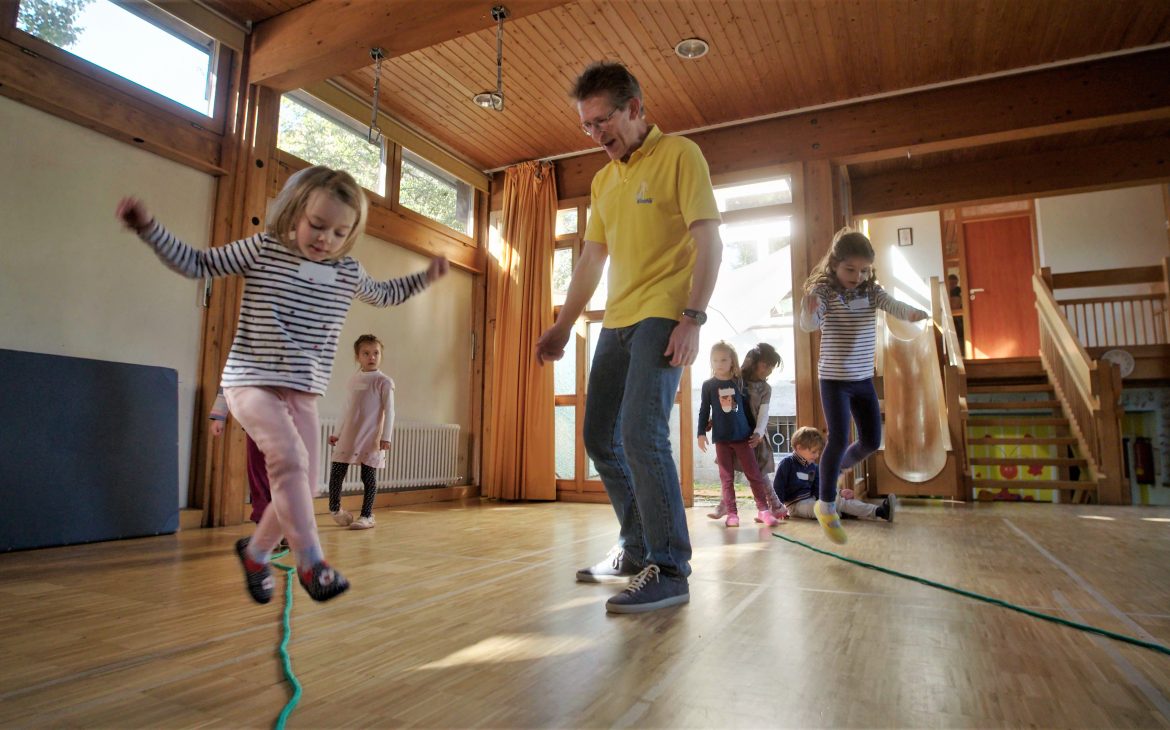
The training suits almost everyone, from children as young as four to seniors. Professional athletes have relied on Life Kinetik for years to sharpen their performance. Enthusiastic advocates include Jürgen Klopp, head coach of FC Liverpool; Andrea Henkel, former biathlete, two-time Olympic champion, and eight-time world champion; and former ski racer Felix Neureuther. People with movement limitations can train too — the coach simply adapts the exercises.

Where can I find a Life Kinetik performance course?
If this has piqued your interest, you can find a Life Kinetik coach near you, or online, here.
My take: After training as a coach under Horst Lutz, I’m genuinely won over by everything this system can do. I’ve felt it firsthand — in my own body, and in my own head — just how much shifts after a few sessions. Better sleep, sharper focus, and a surprising creative boost all caught me off guard. I’ll absolutely be sticking with Life Kinetik.
Find more on Life Kinetik here.
Photos: LiKE GmbH, cover image: Mark Adriane via Unsplash